
MULTIDISCIPLINARIEDAD CIENTÍFICA
DOI:
https://doi.org/10.56067/saetauniversitaria.v14i2.607Abstract
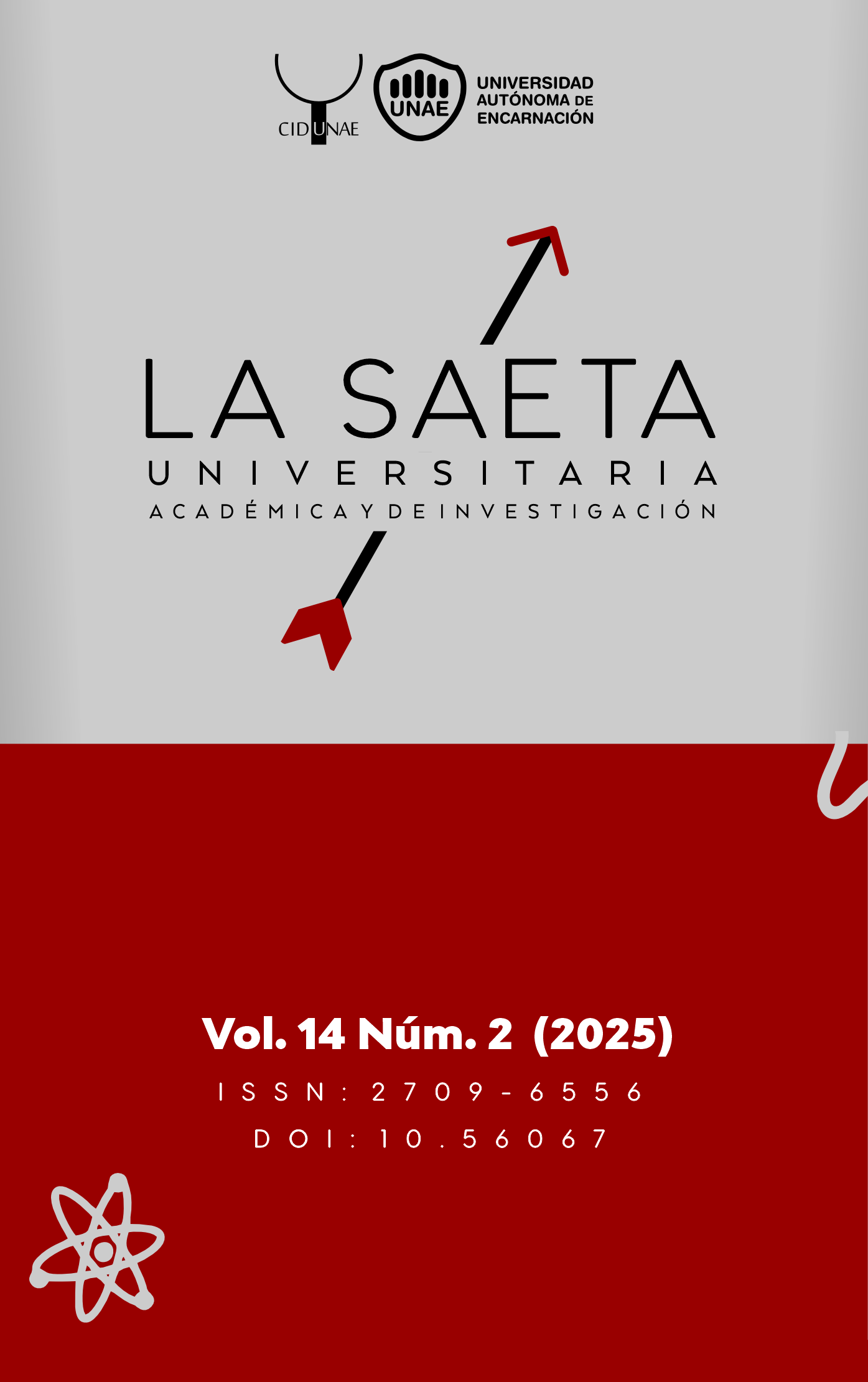
As 2025 draws to a close, volume 14, number 2 of the journal La Saeta Universitaria, Académica y de Investigación (The University, Academic, and Research Arrow) is published.
Editing this issue proved to be a positively complex undertaking, due to several noteworthy factors, including the number of manuscripts received (38), their broad scope across fields such as Veterinary Medicine, Education, Social Sciences, Anthropology, Architecture, Health, and Law, among others; the diverse origins of manuscripts submitted from Spain, Mexico, Ecuador, Colombia, and Paraguay; and the dedication of all those who work toward high-quality science, both as reviewers and authors. This dedication is reflected in the numerous revisions made to the manuscripts, resulting in valuable two-way feedback that strengthened research skills and undoubtedly improved the quality of the manuscripts published in this issue.
This issue features eight manuscripts, listed below:
1. First, from the University of Barcelona (Spain) and Ramon Llull University (Spain), authored by Laura Díaz-Villalba and Montserrat Castelló, the article “PERCEPTIONS OF DOCTORS WITH INTERNATIONAL TRAINING REGARDING THEIR PROFESSIONAL DEVELOPMENT: TASKS, MOTIVATIONS, AND CHALLENGES” contributes to highlighting the career paths of Paraguayan PhDs trained abroad and underscores the need to implement comprehensive government policies that facilitate the (re)integration of international PhDs into the labor market. This is undoubtedly very important information for local institutions that support science and technology, such as BECAL and CONACYT.
2. Second, from the National University of Asunción, specifically from CEMIT, and from Nodal Cutting (Paraguay), the article “INDUCTION OF POLYPLOIDY: EFFECT OF COLCHICINE ON NODAL SEGMENTS OF STEVIA REBAUDIANA (BERTONI) VC. KH/IAN 142 (EIRETE)” by Denice Natalie Álvarez Ramos, Rosa Oviedo de Cristaldo, Edgar Álvarez, and Edith Segovia Corrales describes an experimental procedure on Stevia rebaudiana, a plant native to Paraguay with significant economic and social value.
3. The third manuscript, from the Polytechnic University of Valencia (Spain), is from the Faculty of Architecture and presents an innovative approach to addressing the housing emergency and revitalizing representative urban areas. As its title suggests, this approach focuses on “VERTIC SOLAR” technology. This article is authored by Maria Piqueras Blasco, Ivan Cabrera i Fausto, and Ernesto Fenollosa Forner.
4. The fourth manuscript, from the Universidad del Norte (Paraguay), authored by Matías Vidal Rivarola and Valentina Canese Caballero, is titled “CAUSES OF STUDENT DROPOUT IN THE MUSIC DEGREE PROGRAM AT A HIGHER EDUCATION INSTITUTION” and reveals factors that hinder educational continuity, such as curricular rigidity, limited institutional guidance, and financial difficulties; in addition to dissatisfaction with the training received and a lack of connection with the professional world.
5. The fifth manuscript, titled “COMPETENCIES AND RESEARCH CULTURE OF UNIVERSITY FACULTY AT FACEM-UNICAN, CURUGUATY,” arrived from the National University of Canindeyú (Paraguay) and was authored by José Edmundo Dávalos von Eckstein and Víctor Ariel Ramírez Girett. This article highlights the shortage of university professors with a research profile due to a lack of training and, consequently, low scientific output. It also notes that while scientific production is considered for admission to a teaching position, it is neither an exclusive requirement nor one that is monitored.
6. The sixth manuscript, which addresses one of the current topics, arrived from the National University of Concepción (Paraguay) and is titled “ARTIFICIAL INTELLIGENCE IN EDUCATIONAL RESEARCH AT PARAGUAYAN PUBLIC UNIVERSITIES: ADVANTAGES, LIMITATIONS, AND REGULATORY CHALLENGES.” Authored by Beatriz Ortiz Romero, it highlights the need to establish regulatory frameworks, training strategies, and technical conditions that guarantee the technical, responsible, and contextualized use of AI in educational research.
7. The seventh manuscript, from the Intercultural University of the State of Mexico (Mexico), is titled “THE TEMASKALI: A SYMBOLIC-MYTHOLOGICAL-MAGICAL METHOD OF INHABITATION.” Authored by Carlos Edwin Morón García, Verónica Trujillo Mendoza, and Maribel Pérez Crisóstomo, it deals with the rituals and cosmo-experiential dynamics of existence in the world.
8. Finally, from the National University of Caaguazú (Paraguay), with the signatures of Osvaldo Javier Sánchez Holt, Eduardo Andrés Espínola Correa, Verónica Beatriz Silva Avalos, and Laura Talía Ortellado Sosa, the manuscript “EVALUATION OF TWO ROTATIONAL GRAZING STRATEGIES ON FORAGE PARAMETERS AND WEIGHT GAIN OF CATTLE IN THE YHÚ DISTRICT” covers one of the priority areas.
Downloads
References
.
Published
Issue
Section
License
Copyright (c) 2025 Matías Denis

This work is licensed under a Creative Commons Attribution 4.0 International License.
Este obra está bajo una licencia de Creative Commons Reconocimiento 4.0 Internacional.
Los autores que publican en esta revista están de acuerdo con los siguientes términos:
- Los autores conservan los derechos de autor y garantizan a la revista el derecho de ser la primera publicación del trabajo al igual que licenciado bajo una Creative Commons Attribution License que permite a otros compartir el trabajo con un reconocimiento de la autoría del trabajo y la publicación inicial en esta revista.
- Los autores pueden establecer por separado acuerdos adicionales para la distribución no exclusiva de la versión de la obra publicada en la revista (por ejemplo, situarlo en un repositorio institucional o publicarlo en un libro), con un reconocimiento de su publicación inicial en esta revista.